A complete explant removes more than the implant
Around every implant, the body forms a capsule of scar tissue. A complete explant removes both, together. What is left behind can keep the response going.
What an explant is
An explant is the surgical removal of breast implants. Done completely, it removes more than the implant alone: the capsule of scar tissue that the body forms around it comes out as well. An explant can be performed with or without a breast lift, depending on your anatomy. The sections below explain how the removal is done, and why removing everything matters.
How the removal works
- 01
A capsule forms around every implant
- 02
En bloc removes both as one sealed piece
- 03
Or a total capsulectomy, in sections
- 04
Either way, nothing is left inside
Each step is explained below.
The wall the body builds
When the body cannot remove something, it isolates it, forming a wall of scar tissue around it. This happens around every breast implant, in every woman. That wall is the capsule.
The capsule is not inert. It can hold silicone particles and bacteria, the same factors that may have activated the immune system in the first place. The implant is the source. The capsule is where the evidence remains.
En bloc: implant and capsule together
En bloc means the implant and the capsule around it are removed together, as a single sealed unit. The capsule is never opened, and nothing is released into the surrounding tissue. That containment is the point: if the capsule holds silicone or bacteria, en bloc takes it out intact, rather than risking that it spreads during the surgery.
It matters most when an implant has ruptured, or when gel has been bleeding through a shell that is still intact. In both cases the capsule is already holding silicone that has left the implant. Removing it sealed is what keeps that material from spilling into the body during the operation.
It is a technically demanding procedure. When implants sit beneath the muscle, the capsule adheres to the ribs and to the intercostal muscles that lie directly over the lungs. Separating it cleanly, without entering the chest cavity, calls for a surgeon experienced both in the procedure itself and in chest wall reconstruction. This is why en bloc is not offered everywhere, and why it is reasonable to ask a surgeon how often they perform it.
En bloc is the preferred approach whenever a woman’s anatomy allows it. When it does not, a total capsulectomy reaches the same goal by a different route.
What does not change is how much comes out. When en bloc is not possible, removing the whole capsule is what matters for healing. Leaving part of the capsule leaves everything it holds in place.
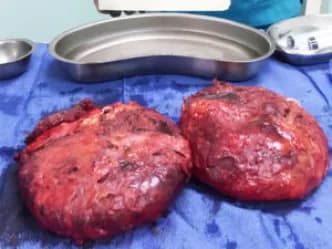
En bloc specimens: implant and capsule, removed as one sealed unit
Capsule left behind can hold
- Silicone from ruptures and gel bleed
- Heavy metals from the implant shell
- Bacteria and the biofilm they build
- In rare cases, BIA-ALCL — a lymphoma linked to textured implants
Total capsulectomy
When a woman’s anatomy does not allow an en bloc resection, the entire capsule is removed in full, in sections rather than in one piece. The objective does not change. Nothing is left inside.
What analysis of the removed tissue shows
The reason complete removal matters is not theoretical. Under the microscope, the capsules removed during explant frequently contain macrophages with silicone inclusions, evidence that silicone had migrated into the tissue, even when the implant shell was intact. Silicone has also been identified in the axillary lymph nodes and, in some patients, elsewhere in the body.
In other words, the material that can sustain the immune response is found in the capsule itself, not only in the implant. That is the scientific basis for removing the capsule completely, and for sending it to pathology when a patient wants confirmation.
Why a partial explant may not resolve the problem
Dr. Urzola’s position is that the substances that activate the immune system are not held in the implant alone. They can remain in the capsule the body forms around it. If the capsule is left in place, the response can continue.
This is why complete removal is the priority, and why the choice of surgeon matters. A partial explant can leave a woman as unwell as she was before her surgery.
Some of the women Dr. Urzola treats had their explant performed elsewhere, and did not recover because part of the capsule was left behind. When it is found and removed, many begin to heal. Results vary from one person to another.
What actually happens
With or without a lift
Skin that was stretched around an implant often loosens once it is removed, and many women have a lift at the same time. Some do not, usually those with smaller implants or good skin elasticity. Dr. Urzola will advise you directly.
Your implants are returned to you
In a sealed medical bag. They travel in your checked luggage, not your carry-on.
Performed by Dr. Urzola himself
Every explant, including the complex cases many surgeons decline.
The questions women ask
What comes next
Have Dr. Urzola review your case
A short, private set of questions helps the medical team understand your situation. It takes about two minutes, and there are no wrong answers.
Get started